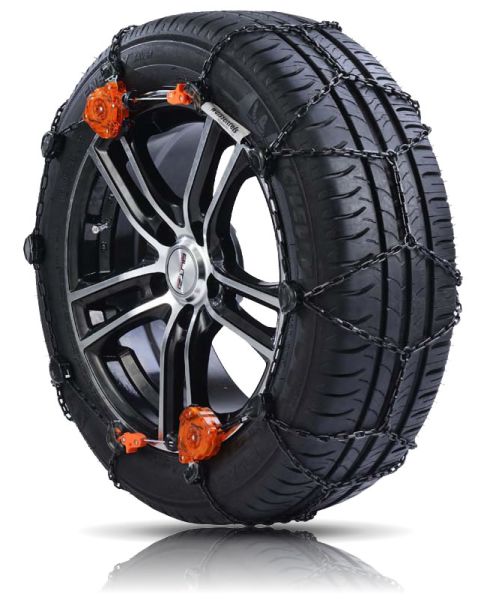
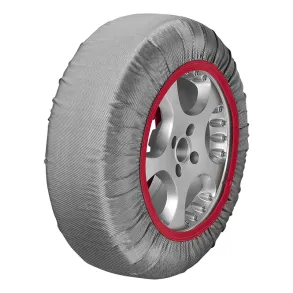
Going on a winter holiday? Then remember snow chains for the car!
There's nothing more frustrating than getting stuck in the Austrian Alps because you didn't bring the snow chains in the car.
In our large selection, you'll find more than 140 different snow chains and snow socks. There are snow chains for passenger cars, vans, SUVs, four-wheel drives, jeeps, etc., as well as snow chains for electric cars.
Are you unsure which snow chains you need? Then scroll down the page to see the most frequently asked questions, or contact us at support@eu.autofix.nufor help finding the right snow chains for your car.
It's no secret that it can be a jungle to find the correct snow chains for the car, especially with more and more electric/hybrid cars on the roads where the requirements can be different.
Read along here, and we'll guide you to the right snow chains.
8 MOST IMPORTANT FAQs ABOUT SNOW CHAINS
Can my electric car use snow chains?
Both yes and no. Most electric cars are equipped with large wheels, often low-profile. Therefore, many models do not allow chains on the back of the tire to avoid interference with mechanical parts. At Autofix.nu, we offer the Polaire Grip and Polaire Steel grip models, which are mounted from the front of the wheel and only grip the tire's tread. Additionally, Polaire is an OEM supplier to the automotive industry. There are also Michelin Easy Grip evolution and Michelin SOS grip, which are approved for some electric cars.
We have created an overview of selected electric cars with suitable snow chains, divided by tire size. You can see the list by clicking here
Why should snow chains be used?
Winter season means winter holiday, and winter holiday means driving on slippery and snowy roads. Here, snow chains or snow socks are your absolutely most important tool!
The snow chains ensure the car's responsiveness and multiply the vehicle's reaction speed (compared to driving without snow chains or winter tires for that matter).
How to mount snow chains and snow socks?
Avoid being in the Austrian Alps without ever having mounted a set of snow chains, always practice at home, this can save you a lot of time!
Is it difficult to mount a set of snow chains? NO, with a little practice, mounting snow chains doesn't have to take more than a maximum of 10 minutes.
A good tip is to read the installation instructions carefully before use, as there can be differences in the procedure, depending on the snow chain model and manufacturer. At Autofix.nu, there is always an installation guide included, or under the product on the website.
Should snow chains be mounted on all wheels?
As a rule, no. It depends on the purpose and usage. For shorter distances, it is recommended to only mount snow chains on the drive wheels.
If you often drive longer distances in such conditions, it is recommended to put snow chains on all four wheels. As the vehicle's axles and gearing can become different with too long unequal driving.
Note: It is recommended that you always read the car's manual for information about the use/requirements of snow chains on your vehicle
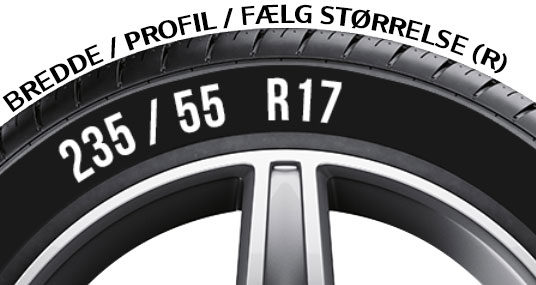
How do I read my tire size?
It is essential for the use of snow chains that the snow chain fits perfectly to the tire size.
In the image below, you can see how to read the tire size, then choose the snow chains or snow socks you want that fit.
What do the different approvals mean?
There are a multitude of approvals and markings with different meanings, it can be a jungle to navigate.
Here we provide an outline of the most commonly used approvals and their meanings.
Snow chains without the following approvals can also be allowed as long as they comply with the individual standards' provisions and are approved for driving in the respective destinations.
Approval
Meaning
GS
The quality of the snow chain is approved as a snow chain within the norm
TÜV/SÜD
German quality mark meaning that the product meets the German rules for quality and safety, with an overall rating
Ö-Norm
Austrian approval, the product meets the Austrian regulations. Ö-Norm V5117. Has been replaced by a single applicable approval covering EU countries - EN EN 16662-1
CUNA
The Italian version of TÜV and Ö-norm
Norsk Standard (NS)
Snow chains with this marking are approved for driving in Norway
EN-Standard
New EU approval for snow chains, making them usable in European countries, replacing the old Ö-Norm. Must be indicated European Standard EN 16662-1. Currently applies in all European countries except Austria
Which snow chains or snow socks are best?
Snow chains in kevlar, snow chains in steel, or snow socks - What is best? The answer will always be car-specific. However, in the car's manual, you can see if there are any special factors you need to be aware of, as there may be requirements for certain types of chains, it may also be that your car does not have space for chains mounted on the back of the tire, requirements for chain thickness, etc. We disclaim responsibility for damage caused to the car due to incorrect installation, use of the wrong type/model chain, or other misuse of chains. ALWAYS check the car's manual for any reservations about the use of snow chains.
Before you order, you should also check if your destination has specific requirements for winter tires and snow chains, and you should be aware of whether the chosen snow chains or snow socks are approved in the respective country. You can see an overview of the common countries' rules by clicking here
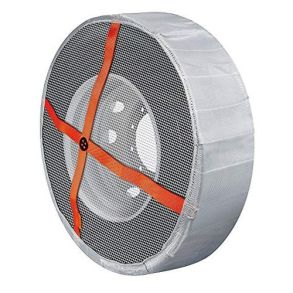
As a rule, snow chains will always be recommended over snow socks, as they provide better traction. Snow socks should only be used in extreme emergencies. However, many snow socks are now approved on equal terms with snow chains.
What does 9, 13, 16, or 17 mm mean?
Often you find snow chains with the designations: 9, 13, 16, or 17 mm, but what does it actually mean? It is the length of the chain link itself and is often an indication that the longer the chain link, the more weight the chain can bear, also called the thickness of the snow chain.
Therefore, snow chains belonging to four-wheel drives and vehicles over 3500 kg have greater thickness.
.w24.h24.png)

.w24.h24.png)